-
Writings
-
Final Blog
During Hurricane Maria, a father who had flown over with his daughter to Puerto Rico conducted an ethnographic research study documenting his observations of the effects the hurricane had on the community. He documented the effects from the hurricane and the damage such as closed roads, fallen trees, debris, and missing streetlights. However, when interviewing residents about the hurricane and the political and historical contexts of traditional herbal practices, he realized he was engaging in a form of Eurocentric ethnography which is a very colonized form of ethnography. Due to this, he shifted his ethnographic research approach from interviewing to instead writing their stories without interviewing.
-
My Bed
The people in my life have always asked the same questions, “What’s wrong with you?” “Why are you always so depressed?” But the question I want to ask without seeming crazy is why aren’t you? Living the human experience is enough justification to be exhausted from reality. Especially if you weren’t lucky enough to be born a rich white man. There are blessings though, having a roof over my head, a sister who’s always there for me, having access to food and clothing. Even being a black girl is a blessing, I wouldn’t choose to be anyone else in any other lifetime. But being a depressed black girl comes with…
-
Autobiography
Jeremiah Arce Professor Rachel Lipscomb Comp 2 6/8/2026 The Final Match: Gold Medal Round Referee Winner… Red!! The anxious couple of minutes, waiting for the results with my arm being held by the ref. My mind was moving like the Daytona 500 and I felt like I was going to be sick. But relief shoots over me as I hear my parents scream, “Let’s go Poppa!!” “Yeah Jay!!”. Red I prepared for this for months. Day in and day out. Constant mental and physical preparation. Hours on the punching bag and conditioning my body to perform the best of my ability. I was working so hard to the point where…
-
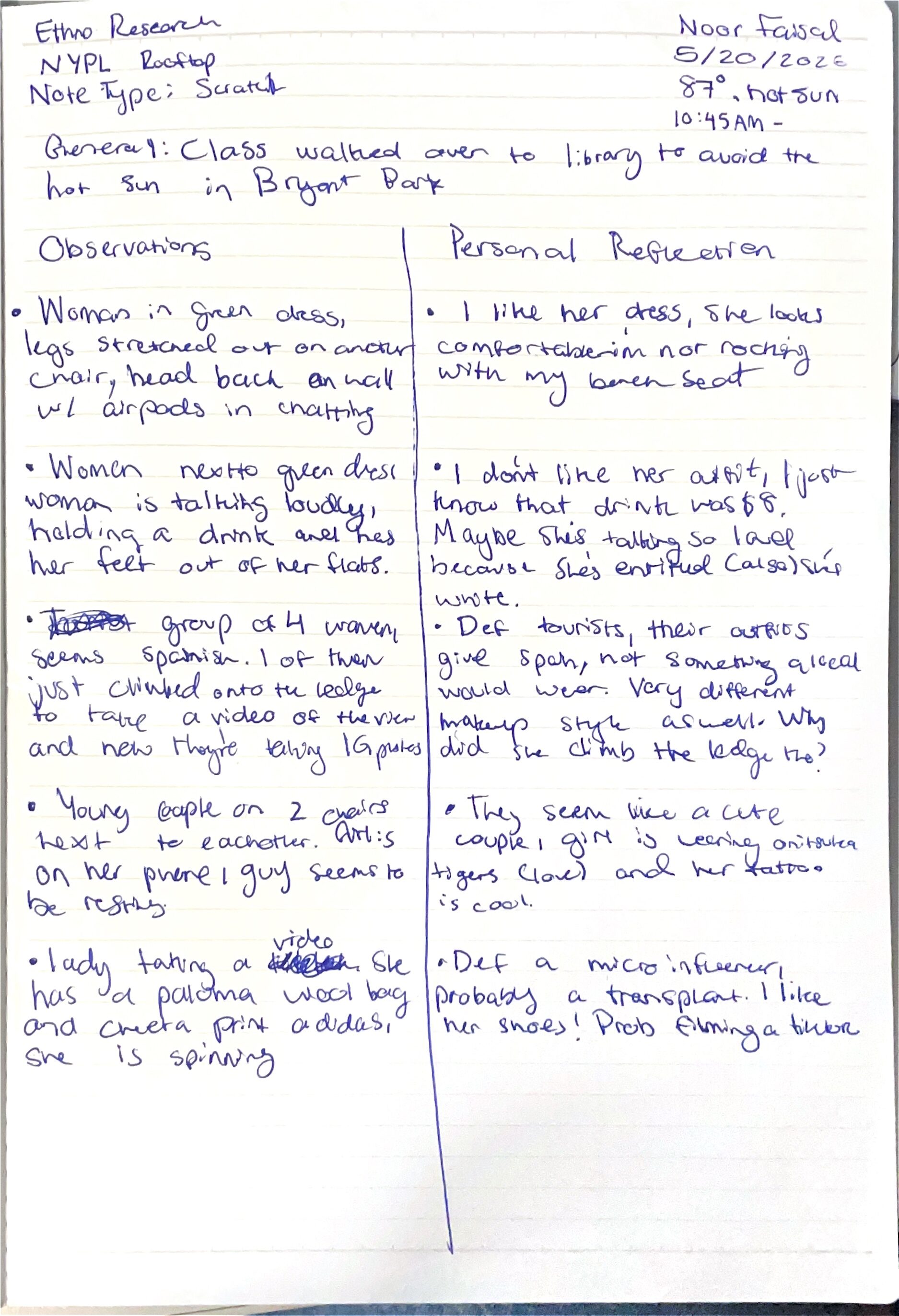
Ethno Observation Notes
from our trip to NYPL rooftop.
-
Interview Questions (blog 8)
Patrick Interview Questions Um I think one of the big misconceptions is that it is all earthy hippies that want to do drugs and have sex when in reality it’s a lot of normal people that work normal jobs and also people think it’s a music festival but it’san art festival people go out there to go see cool art, it’s a lot of fun. I think welnness and party scene two of the most prevelant things out there, there’s so much of the culture out there is “harm reduction” and making sure everyone is healthy as in wearing sunscreen and staying hydrated and that’s something people will talk about and there are jobs dedicated to that. There are resources for people who have a hard…
-
Blog 7
The Venezuelan factory documentary was so interesting to me, there is something so striking about watching workers make choices collectively over production decisions, wages, and workplace conditions. The United States considers Venezuela as a third world country, while that ethical model of labor is largely absent from the country that most loudly claims freedom and individual rights for all. It’s ironic because the United States maintains a labor structure where wage theft is normal, workers have little meaningful say in the conditions of their own labor, and the gap between what a worker produces and what they take home continues to widen. The exploitation is normalized and sugar-coated in the…
-
Blog 6
Reading about the femenist ethnography article reminded me of Margaret Sanger. Although Sanger was a woman, she still held racist views and bigoted ideologies when it came to her research. During her research in Puerto Rico, Sanger was responsible for many unconsented experiments and sterilization in regards to low-income women on the island. She believed in selective breeding and revealed how feminist identity offers no automatic protection against racist and colonial ideology. She was a woman advocating for reproductive autonomy while simultaneously denying it to women she deemed less worthy of reproduction. What makes this relevant to feminist ethnography specifically is the question of positionality and power. Sanger approached Puerto…
-
Autography
The computer woke every night to the sound of corrupted files. They drifted through its system like ghosts—broken photographs, unfinished documents, and audio recordings swallowed by static. Some files opened for only a second before collapsing into error messages. Others had lost their names entirely. The computer spent hours searching through them. It was looking for something important. It just couldn’t remember what. At the center of its case rested the motherboard. Old circuits stretched across its surface like wrinkles. Though years had passed and parts had been replaced, the motherboard remained. Whenever the computer became frustrated, it spoke to the motherboard. “Why can’t I remember?” it asked one night.…
-
Blog 5
Maria Machado’s story unsettled me in a way that felt deliberate and earned. At first you focus on the relentless haunting aspects but underneath all the odd incidents is something subtle about a marriage coming apart. The supernatural elements don’t cause the distance between the two women so much as reveal it and amplify it. The house becomes an externalization of what they can’t say to each other. What struck me most was the ending. After everything they argued about and all the people they brought in to “resolve” the haunting, the narrator opens a door and sees two women from another century, easy and intimate, laughing in bed together.…